Illuminati symbolism appears everywhere—from art and architecture to pop culture. But what do these symbols really mean? This guide reveals their authentic origins, usage, and significance that far transcend sensational stories.
Introduction to Symbolism
Symbols have served as humanity’s universal language for millennia, transcending spoken words to convey complex philosophical, spiritual, and cultural concepts. In the context of secret society symbolism, these visual markers become even more intriguing—they represent coded messages, allegiances, and profound esoteric truths passed down through generations. The study of Illuminati symbols offers a fascinating window into how visual communication shapes belief systems and organizational identity. According to research on symbolism from Encyclopedia Britannica, symbolism operates on multiple levels of meaning, allowing initiates to recognize deeper truths while observers see only surface imagery. Understanding these symbols requires moving beyond conspiracy theories to examine their authentic historical and philosophical foundations.
Common Illuminati Symbols
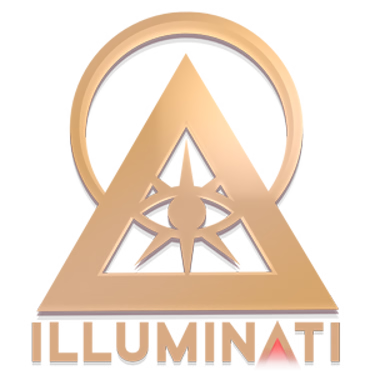
Among the most recognizable Illuminati symbols, the All-Seeing Eye stands paramount. Also known as the Eye of Providence, this symbol features an eye within a triangle, often surrounded by radiating light. The all-seeing eye meaning traditionally represents divine omniscience and spiritual enlightenment rather than sinister surveillance. The pyramid itself symbolizes hierarchy, stability, and the ascent toward enlightenment—with the capstone representing ultimate wisdom or divine consciousness.
The owl of Minerva represents another significant symbol, embodying wisdom, knowledge, and nocturnal insight. In ancient Roman mythology, Minerva was the goddess of wisdom, and her owl companion could reveal hidden truths in darkness. Similarly, the pentagram has been historically associated with various esoteric meanings: when pointed upward, it represents spiritual ascension and the five elements, while its inverted form has taken on different connotations throughout history.
The eternal flame or torch symbolizes enlightenment, knowledge passed from generation to generation, and the illumination of consciousness. According to the Smithsonian Institution’s research on symbolic language, these symbols often carry multiple layers of interpretation depending on cultural and temporal context. The ouroboros—a serpent eating its own tail—represents cyclical renewal, eternity, and the unity of all things, concepts central to many philosophical traditions.
Their Historical & Esoteric Meanings
The esoteric meanings behind these symbols reach deep into ancient mystery traditions, Hermeticism, Kabbalah, and Neoplatonic philosophy. The term “esoteric” refers to knowledge intended for or understood by only a select few—the initiated members who have undergone specific training and rituals. These symbols functioned as visual shorthand for complex metaphysical concepts that would otherwise require extensive philosophical treatises to explain.
The All-Seeing Eye, for instance, traces its lineage through multiple traditions. In ancient Egypt, the Eye of Horus represented protection, royal power, and good health. Christian iconography adopted the symbol as the Eye of Providence, representing God’s watchful care over humanity. When the Bavarian Illuminati formed in 1776, they drew upon these existing traditions to communicate their Enlightenment ideals of reason, knowledge, and human perfectibility. As detailed by the Stanford Encyclopedia of Philosophy, Enlightenment thinkers sought to illuminate minds previously darkened by superstition and ignorance.
The pyramid structure itself embodies the hermetic principle “As above, so below”—suggesting correspondence between the physical and spiritual realms. Each level represents stages of initiation and understanding, with the aspirant climbing from base material concerns toward elevated consciousness symbolized by the capstone. This architectural metaphor appears across cultures, from Egyptian pyramids to Mayan ziggurats, indicating universal human impulses toward transcendence.
Misconceptions and Myths
Perhaps no topic suffers more from misinformation than Illuminati myths and secret society symbolism. Popular culture has transformed historical symbols into sinister conspiracy markers, distorting their original meanings beyond recognition. The most persistent myth suggests that a shadowy Illuminati organization secretly controls world governments, economies, and entertainment industries through cryptic symbols embedded in currency, corporate logos, and music videos.
Historical fact tells a different story. The original Bavarian Illuminati, founded by Adam Weishaupt, existed for barely a decade before being suppressed by the Bavarian government in 1785. This Enlightenment-era group advocated for reason, secularism, and liberal values—not world domination. According to historical research from the Library of Congress, most conspiracy theories about Illuminati influence emerged centuries after the organization ceased to exist, often driven by political anxieties rather than evidence.
Another common misconception conflates all esoteric symbols with malevolent intent. In reality, symbols like the pentagram, triangle, and eye appear across benevolent contexts: churches, academic institutions, civic architecture, and cultural artifacts worldwide. The Eye of Providence graces the Great Seal of the United States not as evidence of conspiracy, but as a symbol chosen by the Founding Fathers to represent divine guidance over the new nation—a meaning well-documented in historical records.
Why Symbols Matter
Symbols matter because they serve as bridges between the tangible and intangible, the known and the mysterious. In studying Illuminati symbols and broader secret society symbolism, we engage with fundamental questions about human meaning-making, collective identity, and the transmission of knowledge across generations. These visual languages allowed organizations to maintain coherence and communicate complex philosophical systems efficiently.
From a psychological perspective, symbols tap into the collective unconscious described by Carl Jung—archetypal images that resonate across cultures and time periods. The pyramid, eye, and serpent appear in diverse civilizations not because of conspiracy, but because they represent universal human experiences: hierarchy, observation, transformation. Modern research from Oxford University demonstrates how symbolic thinking remains central to cognition, helping humans process abstract concepts through concrete visual metaphors.
Understanding authentic symbolism helps combat misinformation and conspiracy thinking. When we examine the historical context and esoteric meanings of these symbols, we discover rich philosophical traditions rather than sinister plots. The study of symbolism reveals how humans have always sought to represent ineffable experiences—spiritual awakening, moral development, cosmic order—through visual means. Whether found in Renaissance art, Masonic lodges, or modern corporate design, symbols continue shaping how we communicate ideas too complex for simple language. By approaching Illuminati symbols with historical rigor and intellectual curiosity rather than paranoia, we honor the genuine wisdom traditions that created them while developing critical thinking skills essential for navigating our symbol-saturated modern world.